
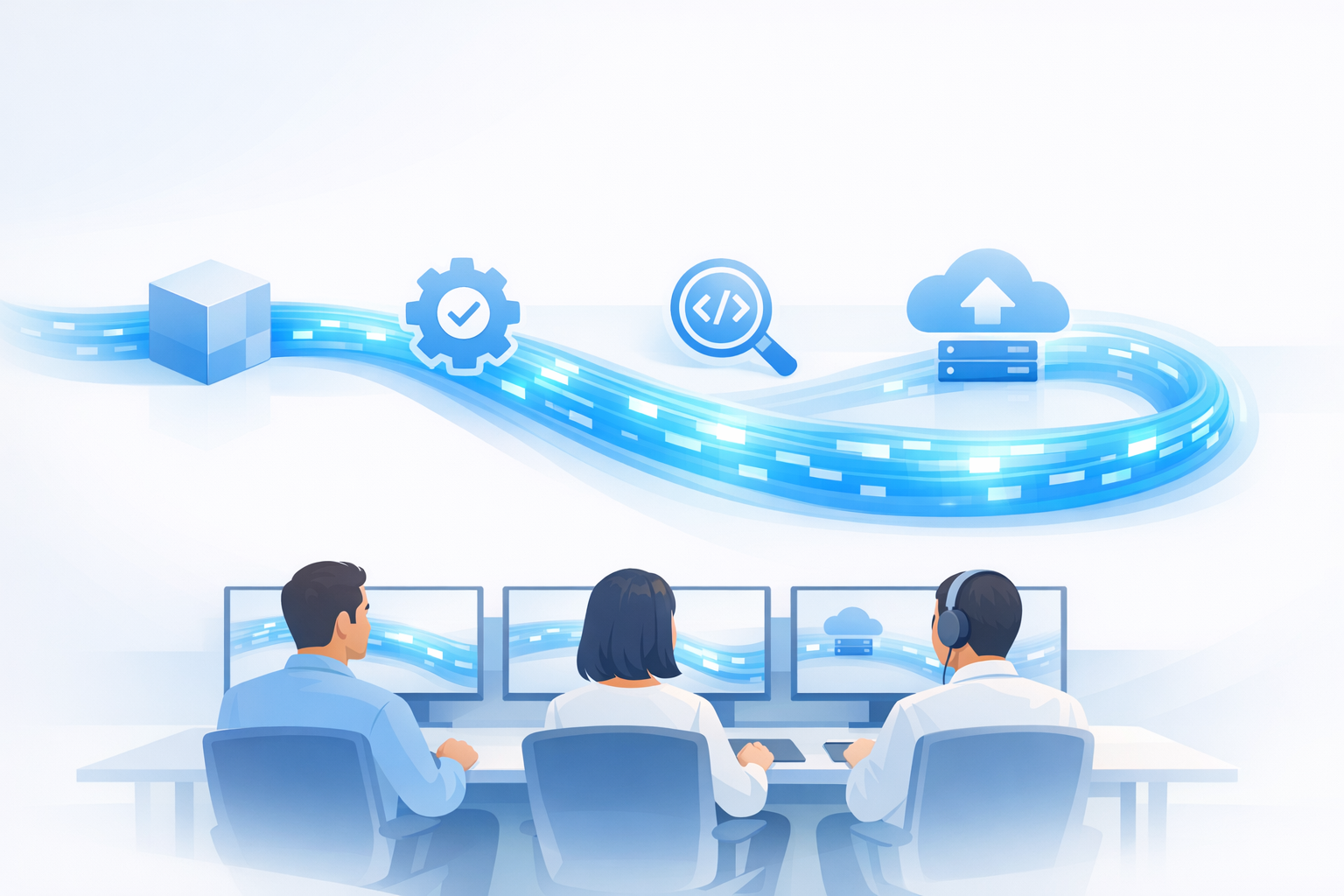
Your CI/CD Pipeline Is Slower Than Your Developers
Published: March 20, 2026
Your developers are fast. Too fast, actually.
They ship code in hours. AI writes half of it. Pull requests pile up. And yet your production environment hasn't changed in three days.
There's a "release window" on Thursdays, isn't there?
The problem isn't your developers. It's your pipeline.
Architecture without delivery is just a diagram
We talk a lot about architecture. Microservices. Event-driven systems. Scalability. But almost nobody talks about the one thing that actually determines whether your system delivers value: how fast you can safely ship to production.
If you can't deploy quickly and reliably, your architecture doesn't matter. It's just a very expensive diagram.
The illusion of productivity
AI made developers faster. You can generate a REST endpoint, validation, tests, and a migration in under 10 minutes. But faster code generation doesn't mean faster delivery, not if the path to production is broken.
I worked on a project where there were no local development environments. By design. The team decided early on that everyone should use ephemeral cloud environments for consistency with production.
Which sounds reasonable, until you see what it means in practice.
Every change had to be deployed to the cloud just to test it. What should have been a 30-second feedback loop became a 15-minute wait. A developer fixes a bug. Deploys to the cloud. Waits. Sees a typo. Deploys again. Waits again.
The fix reached production hours later.
That's not productivity. That's developer buffering.
What "slow pipeline" actually means
A slow pipeline isn't just "CI takes 20 minutes." Sometimes it has nothing to do with CI at all.
On another project, we had regular release meetings. Every release, we sat down and went through the tickets: what's going out, what's in this batch, who needs to know. Standard process.
One of those meetings, we spent 20 minutes going through the list, only to find out the release contained a single frontend change. A space. In a label.
The other two changes we expected to ship had already gone out earlier. Nobody had tagged them as a release. So they never got tracked. And what was left in the batch was a one-character whitespace fix.
We needed a 20-minute meeting to confirm that.
If we had shipped continuously, there would have been nothing to coordinate. The meeting wasn't the problem. Batching was.
Speed is an architectural concern
Most teams treat CI/CD as tooling. "It's just some Jenkins jobs, a few GitHub runners." But it's not. It's part of your architecture.
I've seen this directly. A team split everything into separate repos early on: clean boundaries, independent ownership. It felt like the right call.
But nobody accounted for the dependencies between those repos. Workflows depended on other workflows. There were no contract tests. And without contract tests, the frontend and backend periodically broke each other, not because of bad code, but because there was no automated way to know when one side changed something the other relied on.
Every deployment became a gamble.
The pipeline wasn't slow because of the tools. It was slow because the architecture made independent deployment impossible.
The cost of slow shipping
Slow pipelines don't just waste time. They change behavior.
On that same project, there were 3 code owners for 40 engineers. Every PR had to go through one of them. Reviews were slow, sometimes weeks. So developers started bundling tasks together.
"Why open 3 separate PRs and wait 3 times when you can wait once?"
The result: bigger PRs, harder reviews, higher risk. And when something broke, nobody could tell which change caused it.
Then came the inevitable next step: deploying at night, "just in case."
Congratulations: you've made deployment a stressful event. Which is absurd. Deployment is literally your core capability.
What fast actually looks like
A fast pipeline isn't about raw speed. It's about confidence.
A developer makes a small change, merges it, and it's live in 10 minutes. No drama. A bug reaches production. Rollback takes 30 seconds. No meeting, no panic. A new feature ships behind a flag, enabled when you're ready.
Decoupled. Boring. Predictable.
That's the goal. Because if deployment is exciting, something is very wrong.
How to fix it without enterprise theater
You don't fix a slow pipeline by adding more tools and processes. You fix it by removing things.
Instead of one big PR per day: ten small ones.
Instead of shared database changes: backward-compatible migrations.
Instead of a manual QA gate: reliable automated tests.
Instead of release meetings: continuous deployment.
Every manual approval is a symptom. Every flaky test is technical debt. Every "just in case" process is fear wearing a process badge.
The real question
AI will keep making developers faster. That's not slowing down.
The question is whether your organization can keep up. Because if your pipeline is slower than your developers, you're not accelerating. You're bottlenecking the one thing that actually generates revenue: delivery.
If you're a CTO or a Lead Engineer, and you feel like your team is "buffering" instead of shipping, let's fix that.
I help tech companies bridge the gap between engineering effort and business value. We'll identify the bottlenecks in your process (whether they're in your code, your architecture, or your decision-making) and build a leaner, smarter path to production.
Book a Call to see how we can work together.
